Address
304 North Cardinal St.
Dorchester Center, MA 02124
Work Hours
Monday to Friday: 7AM - 7PM
Weekend: 10AM - 5PM
Address
304 North Cardinal St.
Dorchester Center, MA 02124
Work Hours
Monday to Friday: 7AM - 7PM
Weekend: 10AM - 5PM

 Byadmin
The Day the World Didn’t Stop
You remember launch day, don’t you? The coffee tasted a little richer that morning. The air in the room felt electric. You had poured months—perhaps years—of your life into perfecting a product or service that you knew, in your bones, was exceptional. You pressed ‘publish’ on your digital presence, leaned back in your chair, and waited for the world to notice.
And then… nothing.
No influx of emails. No symphony of notification chimes. Just the deafening silence of a vast, indifferent internet.
This is the universal rite of passage for almost every modern entrepreneur. Unless you are a legacy brand with a century of brand equity, or a venture-backed unicorn with immense capital to burn on a billboard in Piccadilly Circus, launching a business online feels less like a grand ribbon-cutting and more like dropping a message in a bottle into a stormy ocean.
The digital market is ruthlessly democratic, yet infinitely crowded. Establishing your territory requires more than just a good idea; it demands a map, a compass, and an unshakeable strategy. It is a journey of resilience, of trial and error, and ultimately, of mastering the delicate art of business website marketing.
This is the story of how a business fights its way out of obscurity. It is the roadmap for the underdog. If you are ready to stop waiting for the world to find you and start leaving a trail they cannot ignore, turn the page.
Every great novel starts with a conflict, and yours is one of visibility.
In the physical world, a shop on a busy high street guarantees a certain degree of footfall. Passersby look at the window display, intrigued by the lighting or the branding, and wander in. In the digital world, there is no high street—only a labyrinth of algorithms, search engine results pages, and bottomless social media feeds.
In the beginning, your business is entirely invisible. You are standing in the middle of a bustling digital metropolis, screaming your value proposition, but you are effectively a ghost. You quickly realise that having the best product on the market is meaningless if the market doesn’t know you exist.
The first major hurdle is accepting this reality without succumbing to despair. The giants of your industry are already taking up all the oxygen. They dominate the top search results; they have massive marketing departments and seemingly endless budgets. How do you, a challenger brand, carve out a slice of the pie?
The answer is not to shout louder than the giants, but to speak more clearly to a specific audience. It begins with the fundamental realisation that business growth in the modern age isn’t about casting the widest net; it’s about weaving a net so strong and so precisely targeted that the right people inevitably get caught in it. And the anchor of that net? Your digital headquarters.
You cannot mark your territory if you do not have a flag to plant. Your website is that flag.
Far too many businesses treat their website as an afterthought—a static, digital brochure designed simply to tick a box. But in the digital wilderness, your website is your 24/7 salesperson, your brand ambassador, and your storefront all rolled into one. It is the first brick in the empire you are trying to build.
Building this foundation requires architectural precision. This is where partnering with a highly capable website agency becomes the difference between a leaky tent and a fortress. It is tempting, especially when capital is tight, to use a drag-and-drop builder and throw together a site over a weekend. But a truly effective website requires more than just pleasant aesthetics. It requires technical robustness, seamless user experience (UX), and an infrastructure built to convert passing curiosity into tangible revenue.
Think of your website as a physical venue. If the doors are heavy and difficult to open (slow load speeds), if the aisles are confusing (poor navigation), or if the checkout till is broken (clunky payment gateways), the customer will simply leave and walk into a competitor’s shop. A specialist agency understands the deep psychology of web design. They don’t just build pages; they craft user journeys that gently guide a visitor from initial intrigue to final purchase.
Let us imagine you have done it. You have invested in a stunning, high-performing website. The graphics are sharp, the copy is witty, and the mobile experience is flawless. You celebrate, expecting the floodgates to open.
A month passes. The analytics dashboard tells a grim story. Traffic is practically non-existent.
This brings us to the great myth of the digital age: Build it, and they will come.
A beautiful website hidden in the depths of page ten on Google is like a stunning billboard locked inside a dark basement. It doesn’t matter how incredible the design is if there are no eyes to see it. This is the painful epiphany where many business owners falter. They exhaust their budget on development and leave nothing for visibility.
To bridge the gap between existence and discovery, you must seamlessly integrate website and digital marketing. A website is not a finished product; it is a living, breathing engine that requires fuel. That fuel is marketing. Without a cohesive strategy to drive traffic—whether through organic search, referrals, or strategic paid avenues—your beautiful digital headquarters remains a ghost town.
Before you can truly find your voice in the marketplace, you must understand the exact nature of the beast you are trying to tame. The path to business growth isn’t a single, uniform highway. It forks dramatically depending on what changes hands when a transaction occurs. Where your business sits on the brand spectrum dictates exactly how your website and digital marketing strategy must behave.
On one side lies the product-based business—the realm of the tangible. On the other sits the service-based business—the architecture of the intangible.
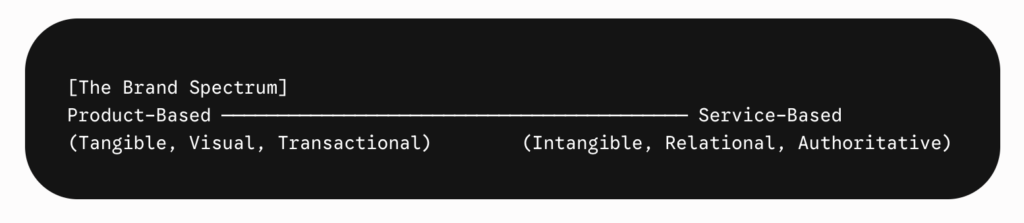
For a product-based business, your position on the brand spectrum is anchored heavily in Visual Utility and Lifestyle Identity. When someone buys a physical item—be it a minimalist watch, a pair of premium leather boots, or a speciality blend of coffee—the initial trust hurdle is relatively low because the human eye can instantly verify the claim.
The digital marketing journey here is a high-speed sprint toward the checkout basket. Your primary challenge is standing out in a sea of identical commodities. Therefore, your website agency must design a digital storefront that functions like a slick, high-speed vending machine. The focus must be on:
Your voice is external, focusing on how the product transforms the user’s daily life or status.
Now, turn your gaze to the service-based business. Here, the psychological landscape shifts completely. You aren’t selling something a customer can unpack from a cardboard box; you are selling an invisible promise of a future outcome. Whether you are an architectural firm, a corporate consultancy, or a technical provider, you sit on the Authority and Relationship end of the brand spectrum.
For a service business, the trust hurdle is towering. Your customers aren’t risking £40 on a whim; they are often risking thousands of pounds and the efficiency of their own operations on your capabilities.
Consequently, the strategy built by your web marketing agency cannot rely on impulse buys. The journey is a marathon of education and relationship-building. Your website must function not as a vending machine, but as a digital boardroom. The focus pivots to:
An underdog brand cannot afford to mistake its position on this spectrum. If you treat a high-ticket service like a transactional product, your website will feel shallow and fail to convert. If you treat a simple product with the agonisingly slow sales cycle of a complex service, you will choke your cash flow.
Only when you know exactly where you sit on this spectrum can you begin to layer on the marketing engines that will drive true, scalable visibility.
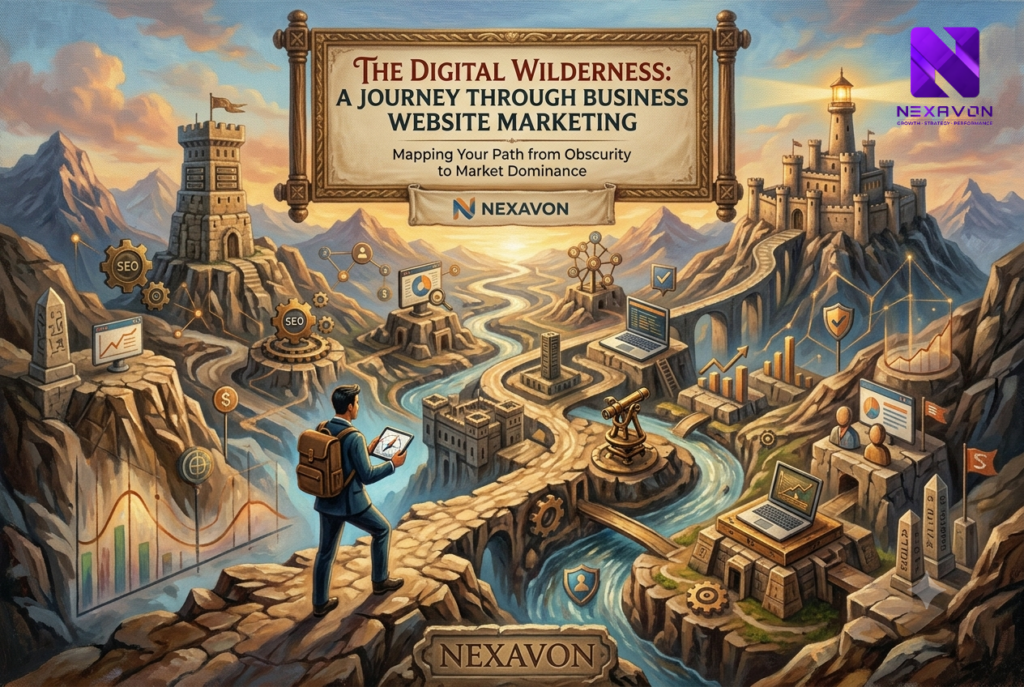
Once you accept that a website without traffic is merely a vanity project, the real work begins. You must step out of the shadows and start communicating with the world.
Business website marketing is the overarching narrative of how you draw people to your domain. It is a multi-faceted discipline that goes far beyond simply placing a link in a bio. It is about crafting a voice that resonates so deeply with your target demographic that they feel compelled to seek you out.
For the non-legacy brand, you cannot rely on brand recognition, so you must rely on brand resonance. What is your unique angle? Why should a consumer trust you over a competitor who has been in the market for twenty years?
Perhaps it is your uncompromising commitment to customer service, or a radically transparent supply chain, or a founder’s story that drips with authenticity. Whatever it is, this narrative must be woven into every piece of content you produce.
Finding this voice often requires an external perspective. This is where a seasoned web marketing agency steps in—not just to execute tasks, but to help you distill your passion into a language the market understands. They help you map out the buyer’s journey, identifying the exact questions your ideal customers are typing into search engines late at night.
Moreover, this is the stage where you begin to look beyond your own domain. Your website is the destination, but the roads leading to it must be paved across the internet. This includes laying the groundwork for social media marketing for website traffic. You start publishing insightful blog posts, sharing behind-the-scenes snippets on social platforms, and offering genuine value rather than just shouting “Buy Now!” into the void.
You are no longer invisible. You are clearing the brush, laying the cobblestones, and putting up signposts. But as you will soon discover, organic growth is a slow burn. The seeds have been planted, but the harvest is still a long way off.
If launching a website is planting a seed, Search Engine Optimisation (SEO) is the agonising wait for the first green shoot to break the soil.
You have done everything right. You’ve partnered with a brilliant web marketing agency to map out your content. Your site architecture is flawless, your meta tags are meticulously written, and your loading speeds are lightning-fast. You publish your first few pillar articles, expecting a sudden surge in traffic.
Instead, you enter what veteran marketers grimly refer to as ‘the sandbox’.
Google and other search engines are inherently sceptical of new domains. In a web flooded with spam and fleeting ventures, search algorithms demand proof of your legitimacy before they offer you a seat at the high table of Page One. They want to see consistent, high-quality content. They want to see other reputable websites linking back to you, silently vouching for your authority.
These are the lonely months. It is a gruelling test of entrepreneurial endurance. You check your analytics dashboard daily, watching a flatline that occasionally blips when your mum visits the homepage. The temptation to pivot, to abandon the strategy, or to declare SEO a scam is overwhelming.
But this waiting period is crucial. It separates the tourists from the residents. While your competitors lose patience, you continue to build. You continue producing content that solves real problems. You slowly earn backlinks. You begin to understand that website marketing is not a sprint; it is an ultramarathon. And just when you are ready to surrender, the algorithm shifts. A blog post lands on page two. Then page one. Suddenly, strangers—real people with real wallets—are finding your website organically. The seed has broken the soil.
While waiting for the slow, heavy wheels of SEO to turn, a non-legacy brand cannot afford to sit idle in the dark. If search engines are the long game, social media is the bustling pub down the road where your customers are already gathered, pint in hand, discussing their problems.
You must go to them.
However, many businesses fundamentally misunderstand the role of platforms like LinkedIn, Instagram, or TikTok. They treat them as digital megaphones, endlessly broadcasting promotional banners. But consumers do not log onto social media to be pitched to; they log on to be entertained, educated, or inspired.
Effective social media marketing for website growth acts as a bridge, not a billboard. It involves joining the conversation natively. You share the behind-the-scenes chaos of your warehouse. You post a raw, honest video from the founder about why the company was started. You offer bite-sized, actionable advice that genuinely helps your target audience.
When you provide value on social platforms, you earn the right to invite them back to your digital headquarters. A well-placed link in a story or a compelling call-to-action in a post stops being an intrusion and becomes a logical next step. Slowly but surely, this social traffic breathes life into your analytics dashboard. You are no longer waiting for people to stumble upon you; you are actively going out, shaking hands, and guiding them home.
Organic growth is beautiful, sustainable, and highly profitable in the long run. But it requires time—the one luxury most growing businesses simply do not have. You have payroll to meet, suppliers to pay, and a market share to capture before a competitor beats you to it.
This is the chapter where you inject jet fuel into the engine. Enter online advertising.
When executed correctly, Pay-Per-Click (PPC) campaigns and paid social media ads are the ultimate equalisers. You don’t need a hundred years of brand history if you can bid smartly on the exact keywords your customers are searching for right now. If someone types “emergency plumber near me” or “B2B accounting software UK”, online advertising allows you to bypass the SEO queue and place your solution directly at the top of the screen.
However, the digital advertising landscape is famously unforgiving. Google Ads and Meta Business Manager are labyrinthine platforms where an inexperienced user can burn through thousands of pounds in a weekend with zero return on investment.
This is the precise moment when many businesses seek the expertise of top-tier online advertising agencies. A specialist agency doesn’t just throw money at a screen. They conduct surgical keyword research, write ad copy that triggers psychological buying cues, and meticulously track conversions. They ensure that every pound spent is an investment, acquiring data that lowers the cost of acquiring a customer over time. With the right paid strategy, the invisible business suddenly becomes omnipresent.
Advertising buys you attention, but attention is fleeting. What actually compels a user to enter their credit card details or fill out a contact form? Trust.
As the traffic begins to flow—whether from your burgeoning SEO efforts, your engaging social media presence, or your sharp ad campaigns—you encounter a new hurdle. People are arriving at your website, but they are hesitant. They do not know you. You are not a household name.
Closing this gap is the essence of masterful website and digital marketing. You must engineer trust into every pixel of your digital presence.
How is this achieved? Through unrelenting social proof. You place glowing customer testimonials prominently on the homepage. You publish in-depth case studies detailing how you solved a complex problem for a client. You ensure your contact information is transparent, featuring a real UK address and a phone number, proving there are actual humans behind the screen.
Furthermore, you offer guarantees, clear return policies, and perhaps a frictionless trial period. You shift your mindset from trying to extract value from the customer to trying to derisk their decision. When a visitor feels safe, the friction melts away, and conversion rates soar. This is how true business growth is sustained.
Every hero’s journey has a destination, a moment when the protagonist is no longer reacting to the world but shaping it. In the digital market, this tipping point is easily identifiable: it is the moment your brand name becomes a keyword.
In the beginning, your traffic came from generic searches. People were looking for a solution, and they happened to find yours. But after months or years of exceptional service, brilliant content, strategic advertising, and an unforgettable user experience, user behaviour shifts.
They stop searching for “best local marketing firm” and start typing your agency’s name directly into the search bar. They bypass the ads. They ignore the competitors. They are looking specifically for you.
You have transitioned from a commodity to a brand. You have successfully claimed your territory in the digital wilderness. Your website is no longer just a digital brochure; it is an authoritative, revenue-generating asset that works tirelessly while you sleep. The journey was fraught with hurdles, steep learning curves, and lonely months, but you survived. You are no longer the invisible business. You are the destination.
Finding and marking your territory in the digital market is not a task you complete; it is a discipline you maintain. Algorithms will update, competitors will adapt, and consumer behaviours will evolve. But the foundational pillars remain unchanged: a robust website, a clear voice, strategic visibility, and an unwavering commitment to building trust.
You do not need to be a legacy brand to win online. You just need a better map, a sharper strategy, and the resilience to keep pushing when the road gets steep. The digital wilderness is vast, but it is waiting to be conquered. Plant your flag.
You know your business is exceptional, but the internet doesn’t—yet. If you are tired of being the best-kept secret in your industry, it is time to partner with a team that knows how to navigate the digital landscape.
At Nexavon, we are not just another website agency; we are architects of digital growth. From building bespoke, high-converting websites to executing data-driven online advertising and comprehensive SEO strategies, we help ambitious UK businesses turn digital obscurity into market dominance.
Stop waiting for the world to find you. Contact Nexavon today, and let’s build your digital empire together.
Delivering marketing strategies that drive real business growth. (See Packages)
If you want to:
→ Partner with a results-driven website and digital marketing company
→ Invest in a professional website agency
→ Build a sustainable digital growth strategy tailored to your business
Business website marketing encompasses all the strategies used to drive targeted traffic to your company’s website and convert those visitors into paying customers. It includes a mix of SEO, content creation, social media marketing, and online advertising tailored to achieve sustainable business growth.
While DIY website builders are fine for hobbyists, a professional website agency builds custom, scalable platforms designed specifically for user experience (UX) and conversion rate optimisation (CRO). They ensure your site is technically sound, secure, fast, and primed to rank highly on search engines—crucial factors that drag-and-drop builders often lack.
Typically, it takes between 3 to 6 months to start seeing meaningful organic traffic from Search Engine Optimisation. It is a long-term strategy that requires building domain authority, publishing high-quality content, and earning backlinks. For faster, immediate visibility, businesses often pair SEO with online advertising.
Yes, especially for non-legacy brands. The digital advertising landscape is highly complex. A specialised online advertising agency will optimise your ad spend, target high-intent buyers, lower your cost-per-acquisition (CPA), and prevent you from wasting budget on poorly configured campaigns.
Social media marketing for website growth is about building brand awareness and trust. By engaging with your audience on platforms like LinkedIn, Instagram, or Meta, you create a community. Sharing valuable content with strategic links drives highly qualified, warm leads directly to your website’s landing pages.