Address
304 North Cardinal St.
Dorchester Center, MA 02124
Work Hours
Monday to Friday: 7AM - 7PM
Weekend: 10AM - 5PM
Address
304 North Cardinal St.
Dorchester Center, MA 02124
Work Hours
Monday to Friday: 7AM - 7PM
Weekend: 10AM - 5PM
 Byadmin
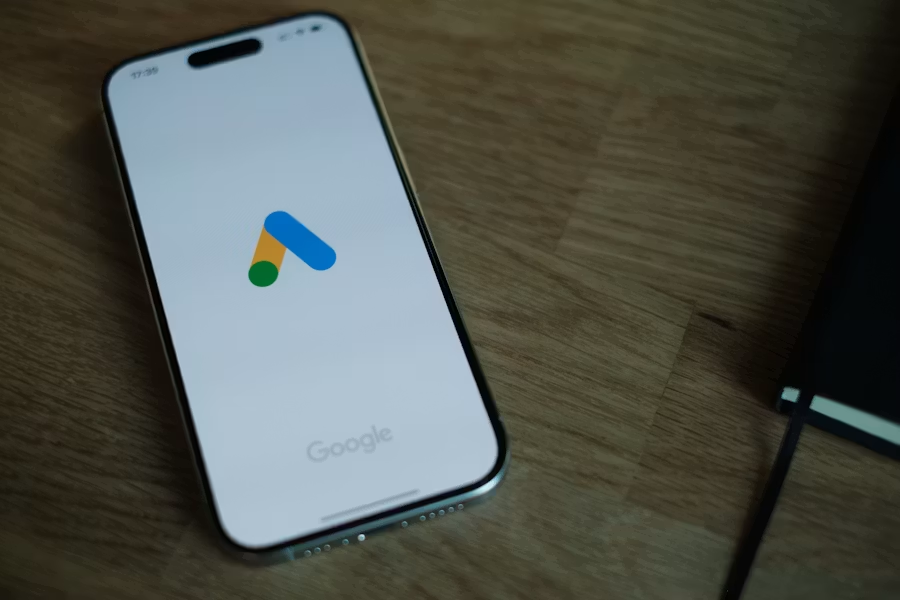
Let’s address the elephant in the room: for many, Google Ads can feel less like a marketing strategy and more like a slot machine.
Countless business owners have dabbled in Pay-Per-Click (PPC) advertising, set up a “quick” campaign using Google’s automated suggestions, watched their monthly budget evaporate in a matter of days with zero phone calls to show for it, and concluded, “Google Ads just doesn’t work for my industry.”
The reality? Google Ads works incredibly well. It is arguably the most potent intent-based marketing tool in existence. But it is an unforgiving ecosystem for the unprepared. When executed correctly, PPC is one of the most powerful levers for immediate, predictable business growth. When executed poorly, it is a fast track to burning cash.
As a leading PPC agency in the UK, we at Nexavon audit dozens of ad accounts every single year. We see the same expensive mistakes repeated time and time again. Here is your definitive guide to demystifying Google Ads, understanding the mechanics behind the platform, and turning your ad spend into a quantifiable investment rather than a dreaded expense.
At its core, Pay-Per-Click is exactly what it sounds like: you buy visits to your site rather than “earning” them organically over time. While Search Engine Optimisation (SEO) is a long-term marathon that builds essential authority, PPC is a sprint.
It allows you to place your business at the very top of Google’s search results today. You are intercepting customers at the exact moment they are typing in a query, signalling they have a problem that needs solving or a product they wish to purchase.
However, capturing that traffic profitably is not as simple as bidding the most money. It requires mastering three core pillars.
The single biggest mistake DIY advertisers make is relying on “Broad Match” keywords. Google’s default settings encourage this, as it maximises their revenue.
If you sell luxury bespoke office furniture and you bid broadly on the keyword “desks,” Google will happily spend your money showing your ad to students looking for “cheap IKEA desks,” or someone searching for “how to build a desk.” You pay for the click, but the user leaves immediately upon seeing your £5,000 price tag.
The Solution: Focus on Exact Match ([keyword]) and Phrase Match (“keyword”) targeting to ensure your ads only trigger for highly relevant searches.
The Secret Weapon: Negative Keywords. A profitable campaign is defined just as much by what you exclude as what you include. By actively building and maintaining a list of negative keywords—adding words like “cheap,” “free,” “used,” “DIY,” or “training”—you prevent your ads from showing to bargain hunters and information seekers. This preserves your budget exclusively for high-ticket, high-intent clients.
Many assume Google Ads is a pure auction: whoever pays the most gets the top spot. This is false. Google doesn’t just reward the highest bidder; it rewards relevance. They want users to have a good experience.
Google assigns a “Quality Score” (from 1 to 10) to every keyword in your account based on three crucial factors:
1. Expected Click-Through Rate (CTR): Based on historical data, how likely are people to click your ad when they see it?
2. Ad Relevance: Does your ad copy perfectly match the user’s search? (If they search for “emergency plumber,” your ad should say “Emergency Plumber,” not just “General Maintenance Services.”)
3. Landing Page Experience: Is the page they land on fast, highly relevant to the search, and easy to navigate?
A high Quality Score acts as a massive discount on your clicks. A competitor could bid £5 per click, but if your ad is highly relevant with a Quality Score of 9/10, you could outrank them while only paying £3 per click. Mastering Quality Score is how you beat larger competitors with bigger budgets.
You can build the perfect campaign structure, write compelling ad copy that drives a massive CTR, and target the exact right audience. But if you send that hard-earned traffic to a generic, slow-loading homepage, your campaign will fail.
Never pay for traffic without a dedicated website marketing strategy for the landing page. If a user clicks an ad for “commercial roof repairs London,” they should not land on your homepage, where they have to hunt for your roofing services.
They must land on a dedicated, lightning-fast page specifically about commercial roof repairs. This page must include a clear call-to-action (CTA), robust trust signals (reviews, industry accreditations, guarantees), and a phone number or lead form front and centre. Your landing page’s only job is to convert that click into a lead.
The Google Ads platform of today is vastly more complex than it was even two years ago. With the aggressive push towards AI-driven Performance Max (PMax) campaigns, complex automated bidding algorithms (Target CPA, Target ROAS), and strict conversion tracking requirements, managing a profitable account is no longer a side task. It is a full-time, highly technical job.
Top digital marketing agencies in the UK don’t just “set and forget” campaigns. They conduct daily bid adjustments, run continuous A/B split tests on ad copy to improve CTR, refine audience demographics, aggressively manage search terms reports, and meticulously track offline conversions to ensure every pound spent correlates to real-world revenue.
If your current PPC campaigns are underperforming, draining your budget without delivering leads, or if you are ready to launch your first truly profitable campaign, it’s time to bring in the experts.
As a premier digital marketing company in the UK, Nexavon specialises in taking the guesswork out of Google Ads. We build hyper-targeted, data-driven campaigns designed to lower your cost-per-acquisition (CPA) and scale your lead generation predictably.
Don’t let your competitors monopolise the top of Google while you rely on outdated marketing methods. Contact Nexavon today for a comprehensive, no-obligation PPC audit, and let us show you how to turn your ad spend into serious ROI.
→ Partner with a results-driven digital marketing company
→ Invest in a professional lead generation agency
→ Build a sustainable digital revenue stream
PPC stands for Pay-Per-Click, an online advertising model where advertisers pay a fee each time one of their ads is clicked. Essentially, it’s a way of buying visits to your site, rather than attempting to “earn” those visits organically through SEO.
Google Ads operates on an auction system. Advertisers select a list of keywords relevant to their business and place “bids” on how much they are willing to pay for a click. When a user searches for one of those keywords, Google evaluates the bids and the “Quality Score” of the ads to determine which ads appear at the top of the search results page.
Quality Score ranges from 1 to 10. Scores of 7 to 10 are excellent and lead to lower costs-per-click and better ad placement. Scores of 4 to 6 are average, indicating room for improvement, while 3 or below signifies high irrelevance to the keyword, resulting in higher costs.
If you’re getting clicks but no conversions, the issue is likely poor targeting or a weak landing page. You may be using broad match keywords that attract irrelevant traffic, or your landing page may be slow, confusing, or lacking a clear call-to-action.