Address
304 North Cardinal St.
Dorchester Center, MA 02124
Work Hours
Monday to Friday: 7AM - 7PM
Weekend: 10AM - 5PM
Address
304 North Cardinal St.
Dorchester Center, MA 02124
Work Hours
Monday to Friday: 7AM - 7PM
Weekend: 10AM - 5PM
 Byadmin
For independent retailers, hospitality venues, and B2B service providers operating across North Yorkshire, the digital landscape presents a unique set of geographical and demographic challenges. Whether you are running a boutique hotel in the Yorkshire Moors, a bustling restaurant in the centre of York, or an agricultural supply firm in Skipton, relying strictly on passing footfall or traditional print advertising is no longer a viable growth strategy. To capture both the loyal local market and the massive influx of seasonal tourists, your digital storefront must be as visible and inviting as your physical one.
The bridge between your local community and your digital storefront is Facebook marketing. Despite the rise of newer platforms, Facebook remains the dominant social engine for local community engagement in the UK. However, generating “likes” on a post does not pay the bills. True commercial success requires engineering your social media presence to execute relentless, high-converting website promotion.
This comprehensive guide details exactly how North Yorkshire businesses can transition from passive social media posting to utilising advanced Facebook advertising and organic strategies to drive targeted, revenue-generating traffic directly to their websites.
The days of treating a Facebook Business Page merely as a digital noticeboard for opening hours are over. Meta’s algorithm heavily prioritizes localized, community-driven content. If your business is not actively participating in this ecosystem, your competitors are actively capturing your market share.
Historically, businesses would cast the widest net possible with their advertising budgets, hoping to capture a fraction of a per cent of a national audience. For a regional SME, this is a phenomenal waste of capital.
Facebook marketing North Yorkshire strategies must focus on hyper-local community integration. The algorithm rewards content that generates meaningful interactions among users in the same geographic vicinity. When a local resident comments on your post, their extended network of local friends is significantly more likely to see that content. By focusing your messaging on regional pride, local events, and community-specific pain points, you naturally amplify your organic reach without spending a penny on ads.
North Yorkshire possesses a dual economy. You have a deeply rooted local population, and you have millions of tourists flocking to historical hubs like York, Harrogate, and Whitby every year. A generic marketing strategy will fail to resonate with either group.
Your Facebook strategy must be bifurcated:
Advanced Facebook advertising allows you to separate these audiences effortlessly, serving bespoke website promotion campaigns tailored exactly to their immediate intent.
Hitting the “Boost Post” button on your timeline is the fastest way to drain your marketing budget with zero return on investment. To drive meaningful traffic that actually converts into bookings, sales, or enquiries, you must utilise the Meta Ads Manager and build structured, intent-driven campaigns.
The most powerful tool for a local business on Facebook is geographic radius targeting. If you run a bespoke furniture showroom in Harrogate, you do not need to advertise to people in London.
By dropping a pin on your exact postcode within the Ads Manager, you can set a strict 10-mile or 15-mile radius. You can further refine this by telling Facebook to target only people who “live in this location” (perfect for high-ticket home services) or people who are “recently in this location” (perfect for restaurants and tourist attractions trying to capture day-trippers). This ensures every ad impression is served to a prospect who can realistically walk through your doors.
When setting up an ad campaign, Facebook asks for your ultimate objective. If you select “Engagement,” Facebook will show your ad to users who habitually click “like,” but rarely leave the app.
To execute effective local website promotion in the UK, you must select the Traffic or Sales/Lead Generation objectives. This instructs the Meta algorithm to find users within your North Yorkshire radius who have a historical track record of clicking external links, filling out contact forms, or completing e-commerce checkouts. You are essentially paying for high-intent actions, rather than vanity metrics.
The reality of digital marketing is that 97% of first-time website visitors will leave without taking action. If you do not have a system to bring them back, you lose them forever.
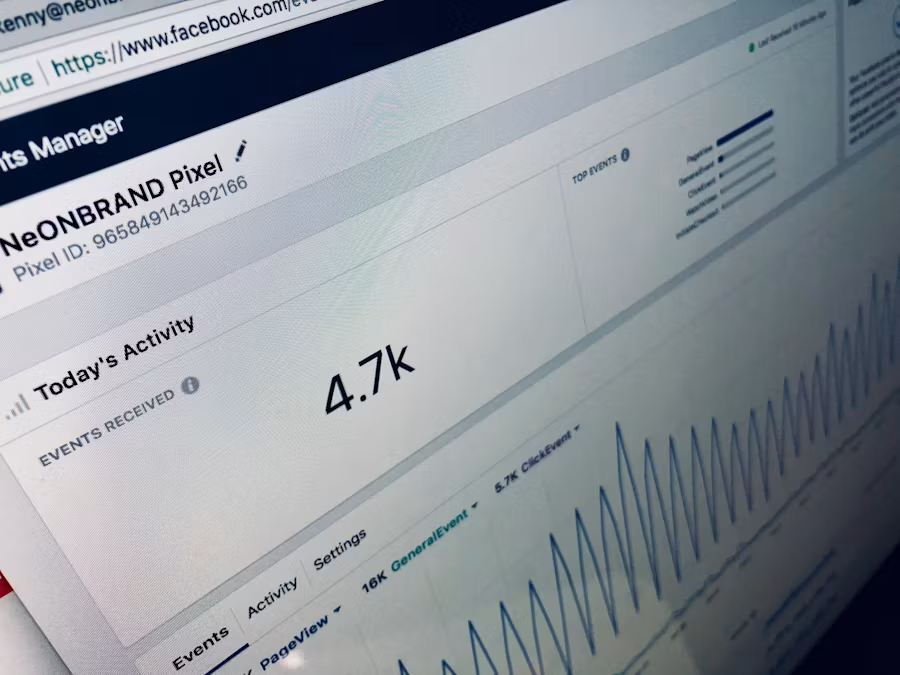
By installing the Meta Pixel (a small piece of tracking code) on your website, you can track exactly who visited your site, which specific product or service pages they looked at, and whether they completed a purchase. You can then build a “Custom Audience” in Facebook to retarget those exact individuals.
For example, if a user visited your York hotel’s booking page but did not complete the reservation, they will log into Facebook an hour later and see a highly targeted ad: “Still planning your York getaway? Book directly through our website today and receive a complimentary breakfast.” This is the most profitable form of advertising available to local businesses.
While paid advertising is the most predictable way to scale website traffic, a robust organic strategy establishes the trust and authority necessary to maximise your conversion rates.
Your Facebook Business Page is often the first touchpoint a prospective customer has with your brand. It must be optimised for conversion.
North Yorkshire is home to hundreds of highly active community Facebook groups (e.g., local business networks, village noticeboards, and county tourism groups). These groups are goldmines for local website promotion, but they must be navigated carefully.
If you join these groups and immediately start dropping links to your products, you will be banned for spamming. The strategy is to provide overwhelming value. Answer local questions, share expertise related to your industry, and establish yourself as a helpful community pillar. When a user inevitably asks for a recommendation related to your services, you can then organically link them to the relevant page on your website, driving highly qualified, warm traffic.
If your business hosts events, workshops, or seasonal sales, Facebook Events are incredibly powerful. They naturally gain algorithmic traction when users click “Interested,” broadcasting that action to their friends.
However, never rely on Facebook to manage the actual ticketing or registration. Always use the “Tickets” link field within the event setup to drive users directly to a specific landing page on your website. This ensures you capture their email address for future marketing, rather than leaving that valuable data in Facebook’s hands.
Operating a marketing campaign without rigorous tracking is akin to driving blindfolded. You must be able to empirically prove that your Facebook efforts are directly contributing to your bottom line.
The Meta Pixel will report on exactly how many leads or sales were generated directly from your ads. However, you must cross-reference this data with Google Analytics 4 (GA4) on your website.
By looking at the “Traffic Acquisition” reports in GA4, you can see how long users from Facebook are staying on your site, which pages they navigate to, and whether they bounce immediately. To track organic posts accurately, always use UTM parameters (custom tracking tags added to the end of your URLs) when you post a link on your Facebook page. This allows GA4 to tell you exactly which specific organic post generated a sale.
To determine if your Facebook marketing is profitable, you must calculate your Cost Per Acquisition (CPA). If you spend £500 on localised radius ads and generate 20 qualified leads, your CPA is £25.
If your average lifetime customer value is £500, spending £25 to acquire them represents a massive Return on Investment (ROI). By continuously testing different ad copy, images, and landing pages, a specialised agency will methodically drive this CPA down over time, increasing your profit margins.
Mastering the intricacies of the Meta Ads algorithm, producing scroll-stopping creative, and building high-converting landing pages requires a diverse set of highly technical skills. For a local business owner already stretched thin managing daily operations, attempting to execute this internally often leads to frustration and wasted capital.
Partnering with a specialist social media agency Yorkshire businesses trust is the most efficient path to predictable digital growth. At Nexavon, we do not just manage social media accounts; we engineer comprehensive, omnichannel revenue pipelines. We integrate expert Facebook media buying with bespoke web design and technical SEO, ensuring that every click generated on social media lands on an architecture explicitly designed to convert.
See what your business could potentially unlock with a stronger digital marketing strategy.
Unlock your complete revenue growth report and discover where your digital marketing could generate the biggest gains.
*Estimates are illustrative projections based on the information provided and are not guaranteed results.
If you are ready to transform your local digital presence into a measurable revenue engine, connect with the Nexavon strategy team today to discuss a bespoke growth blueprint for your North Yorkshire brand.
The cost of localised Facebook Ads in the UK is highly flexible, allowing businesses to set their own daily budgets. For a local North Yorkshire business testing the waters, a starting budget of £10 to £15 per day is sufficient to gather data and generate initial traffic. However, to see consistent, scalable lead generation, most SMEs typically invest between £500 and £1,500 per month in ad spend, adjusting based on the measurable Return on Ad Spend (ROAS).
Absolutely. While younger demographics heavily utilise platforms like TikTok and Instagram, Facebook remains the dominant platform for community-centric engagement and local business discovery in the UK. Furthermore, Meta’s advertising platform (which controls both Facebook and Instagram) possesses the most sophisticated, granular geographic and demographic targeting capabilities available to local advertisers today.
Boosting a post is a simplified, automated feature designed to maximise superficial engagement (likes, comments, and shares) from your existing audience and their friends. It lacks advanced targeting and conversion tracking. The Facebook Ads Manager is a professional, backend advertising platform that allows you to build complex campaigns, utilise radius targeting, implement the Meta Pixel for retargeting, and specifically optimise for bottom-of-the-funnel actions like website purchases and lead form submissions.
To promote your website organically (for free), you must focus on value-driven content. Share blog posts that solve specific problems for your local audience, post behind-the-scenes videos of your business operations, and actively participate in local North Yorkshire community groups. Always ensure your website URL is prominently featured in your page’s “About” section, pinned posts, and strategically placed in the comments of highly engaged discussions where relevant.